Every pipe spec, cited to its source.
A provenance-tracked catalog of infrastructure-component specifications.
Pipe dimensions, material codes, structural strength, and hydraulic roughness live scattered across standards, manufacturer guides, and utility asset-code specs. HydroDSS assembles them into one normalised, cited reference that maps a nominal term — "DN225 PVC" — to physical geometry plus mechanical and hydraulic properties. It auto-populates model parameters so engineers don't hand-key them, and it's a fast spec lookup you can use before you're a customer. Every value carries its source citation. Treat it as facts derived from cited sources, and verify against the source for engineering use.
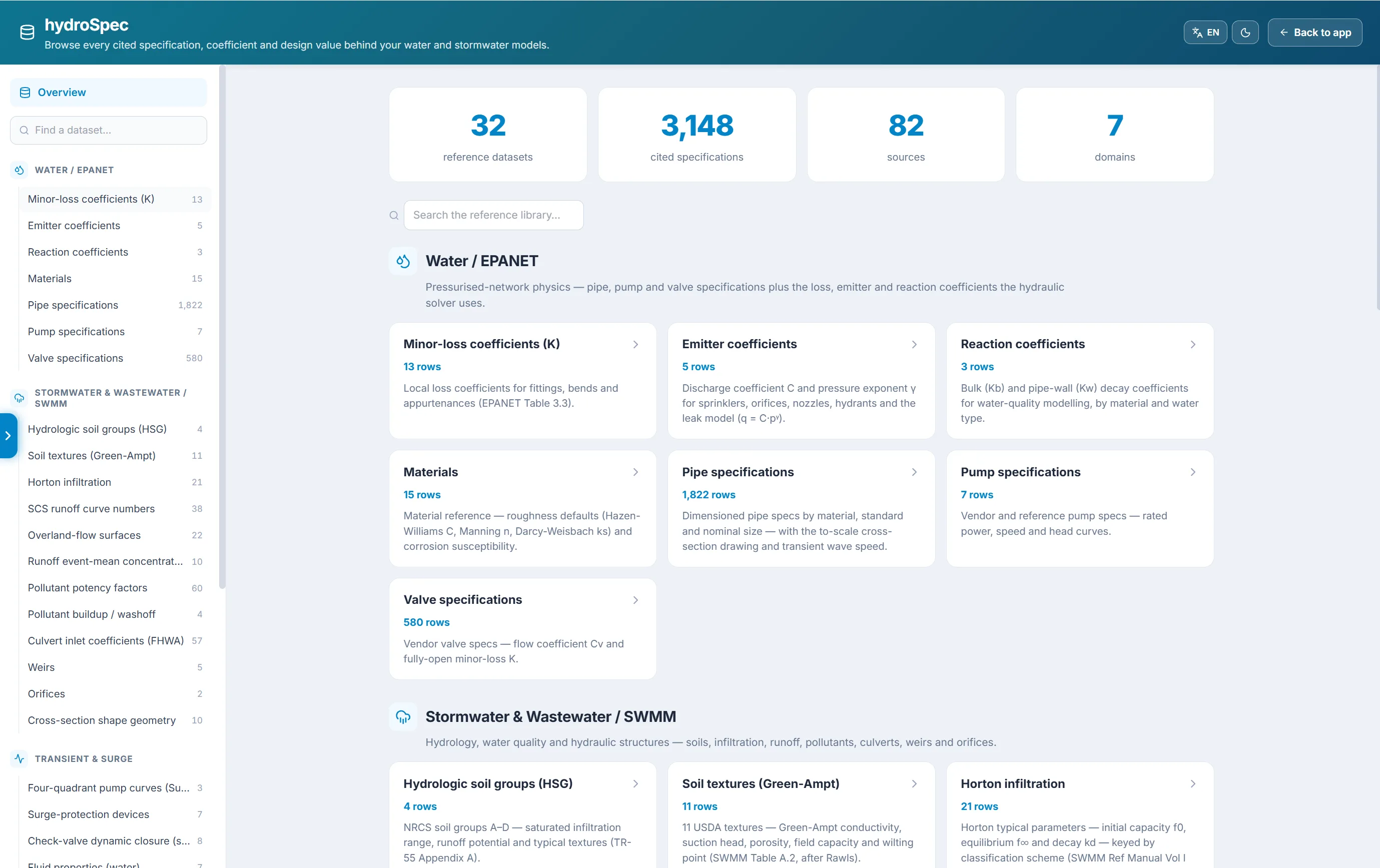
hydroSpec inside the app — the cited reference library behind every model parameter.
Build-complete on pipes, and growing across the whole model.
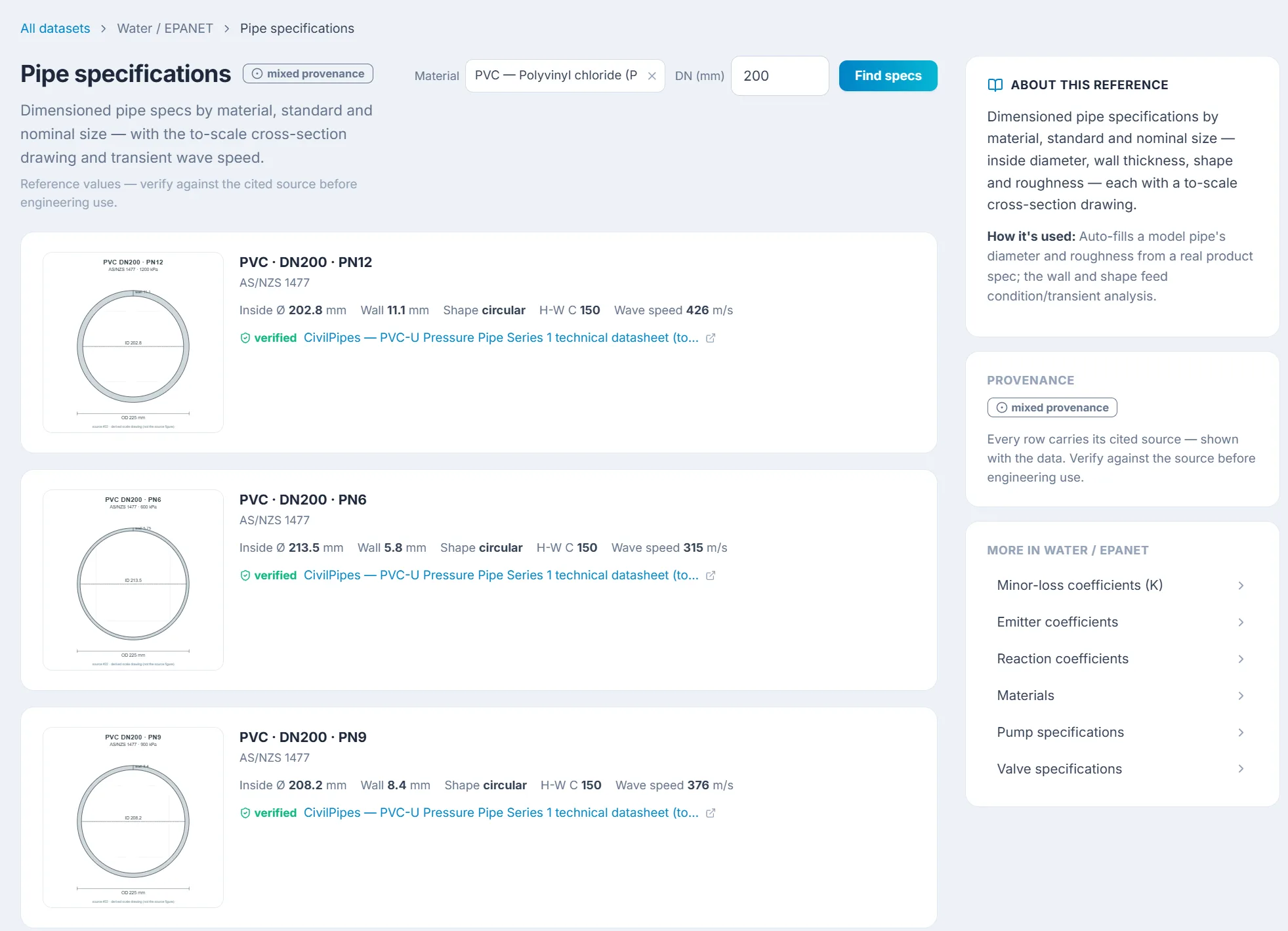
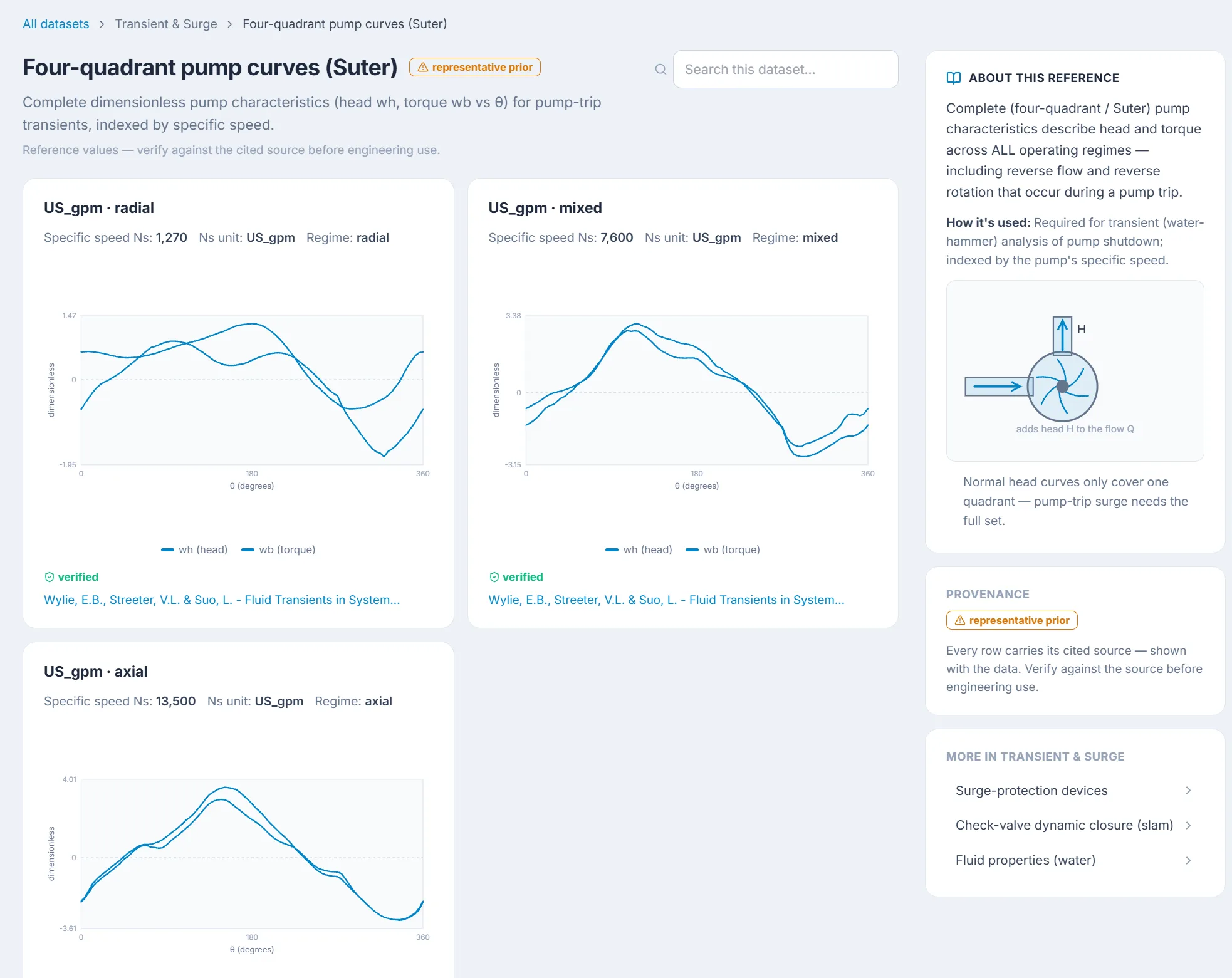
The deepest dataset is pipes — 1,822 dimensioned specifications, complete across every major family, each with a to-scale cross-section. Around it, the library spans the rest of what a model needs: pump and valve specifications, loss, emitter, and reaction coefficients, stormwater hydrology parameters (soil groups, infiltration, runoff), and the transient-and-surge reference set. Utility crosswalks and manufacturer data keep coming — with the verify-against-source caveat that honesty requires.
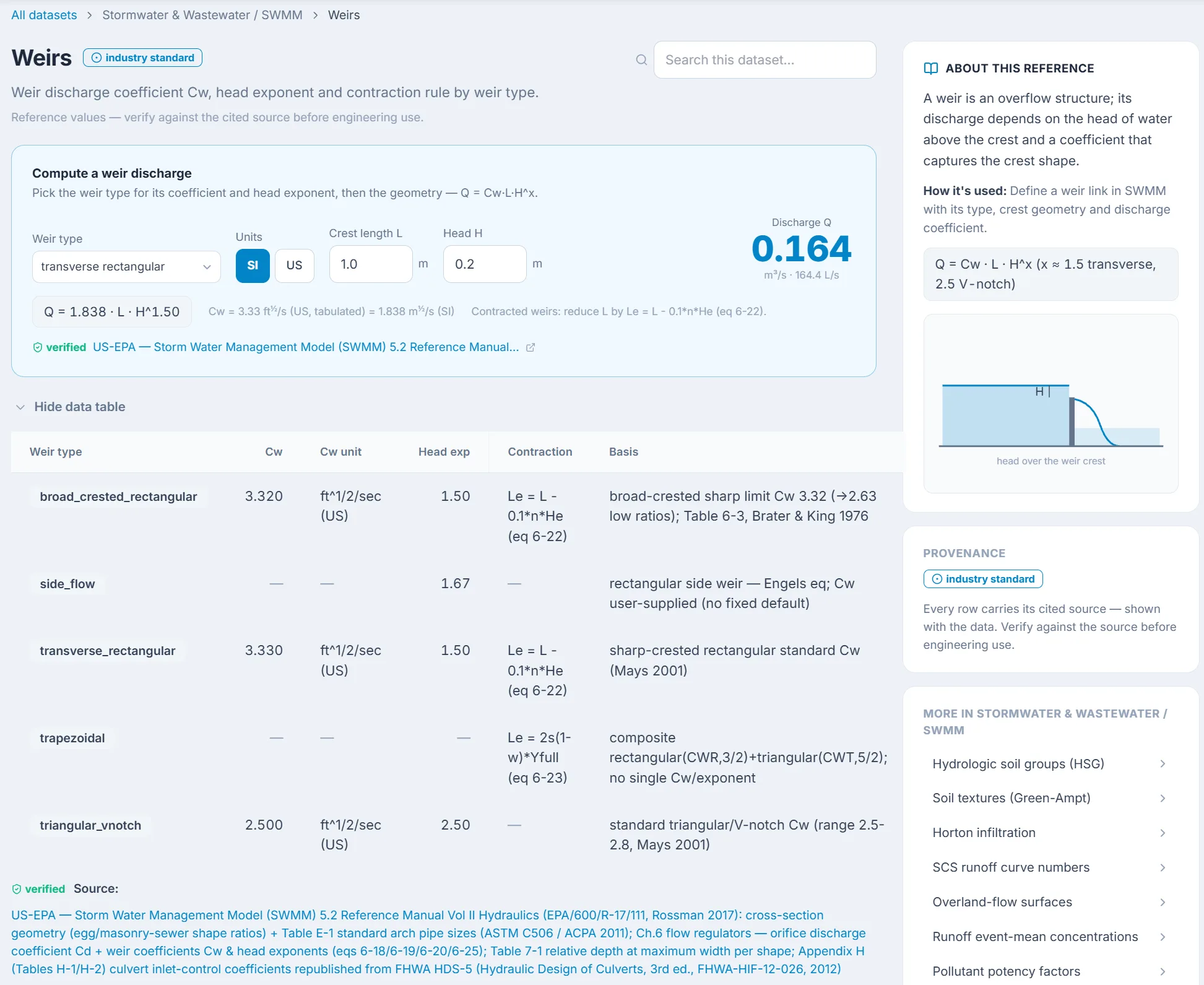
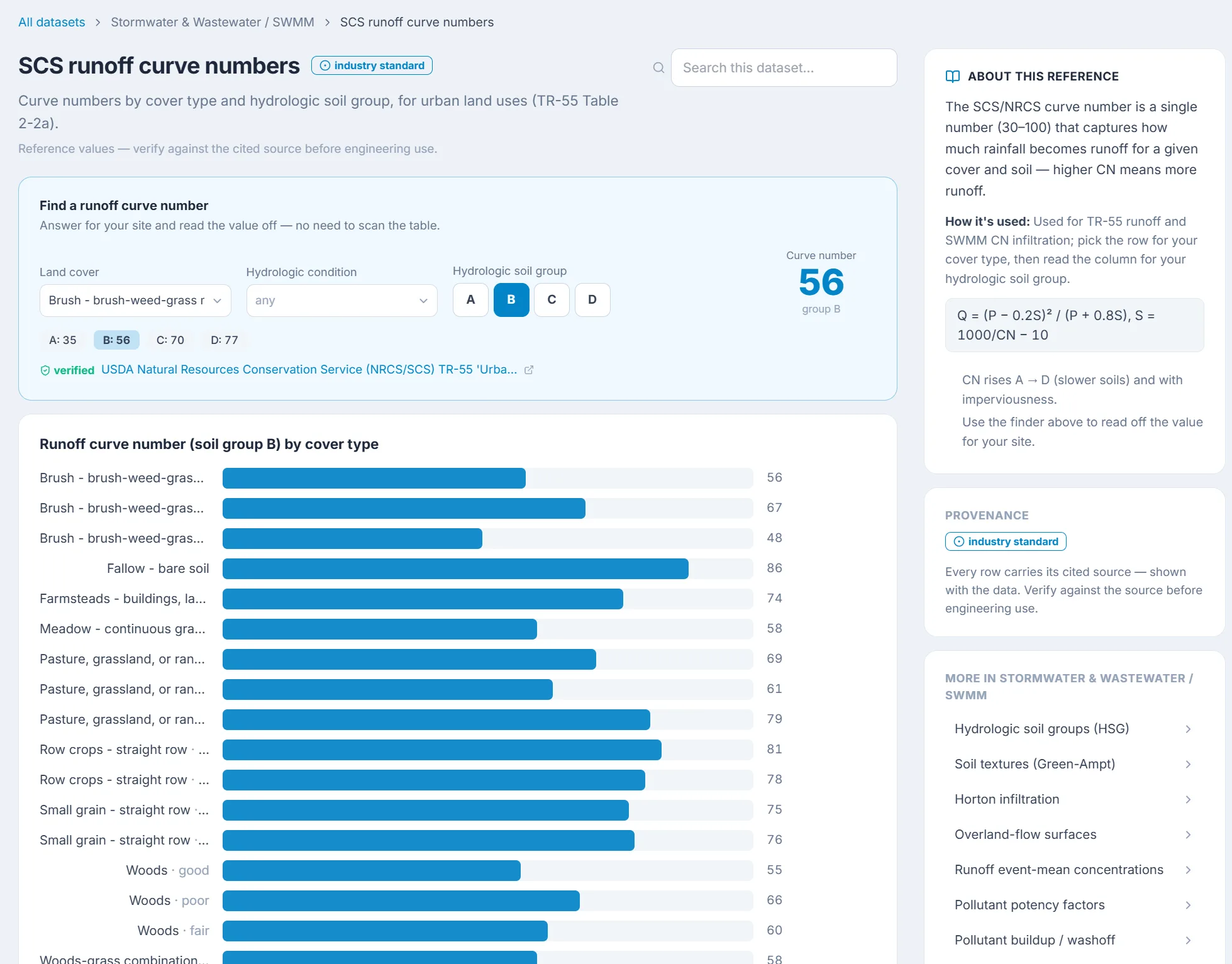
Coverage by family
- Plastics — PVC-U / PVC-M / PVC-O, PE, PP, ABS
- Concrete — reinforced and pressure
- Vitrified clay
- Metals — steel, stainless, copper, ductile iron
- Legacy — asbestos cement, cast iron, GRP
- Non-circular — box, arch, egg / ovoid
From a nominal term to physical reality.
One row resolves a nominal pipe or component term into the numbers a model and an asset register actually need.
Dimensions & shape
Outside / inside diameter, wall thickness, and cross-section shape — circular through box, arch, and egg / ovoid.
Strength & class
Strength class, ring stiffness and crush load, material codes — the structural side that condition and collapse-risk scoring need.
Roughness defaults
Hazen-Williams and Darcy-Weisbach roughness defaults, so a model parameterises from material and size instead of a hand-keyed guess.
It's also the connective tissue between the models and the data Foundation: it auto-populates pipe parameters and underpins the condition → roughness / effective-diameter loop that turns inspection findings into hydraulic consequences.
Every row shows where it came from.
A spec is only as trustworthy as its source. Every row carries a citation and a trust tier, so you can see the provenance before you rely on a number — and verify against the source for engineering use.
Independently verified
Cross-checked against a cited public-domain or standards source. The citation names exactly which document the value came from.
Vendor attested
Supplied and stood behind by a manufacturer. Labelled as such — never presented as independently confirmed.
"Verified" means provenance, not correctness. It records that a value came from a named, consented source — not that we certify the number for your design. The cited standard or manufacturer remains the authority; payment never biases ranking or fit.
Search opens inside the app.
Search by material × DN × class and get geometry and hydraulic parameters back, each row showing its citation. The searchable library lives inside the HydroDSS app behind a free account — sign up free and it's yours today, alongside the models it parameterises.
Use the catalog on your own model.
Inside the HydroDSS app, the catalog auto-populates asset parameters from a material and a size — every value cited, with its provenance carried into the model. Sign up free and apply a catalog spec to your own network.
Get your products listed.
List your pipe, pump, and valve specifications as vendor-attested rows, cited to you. Write to us to start the conversation.
No manufacturer logos and no implied endorsement appear here — a vendor presence reflects a real listing, not a current fact, until one is signed. The catalog is part of the data Foundation and feeds the models and the future condition AI.